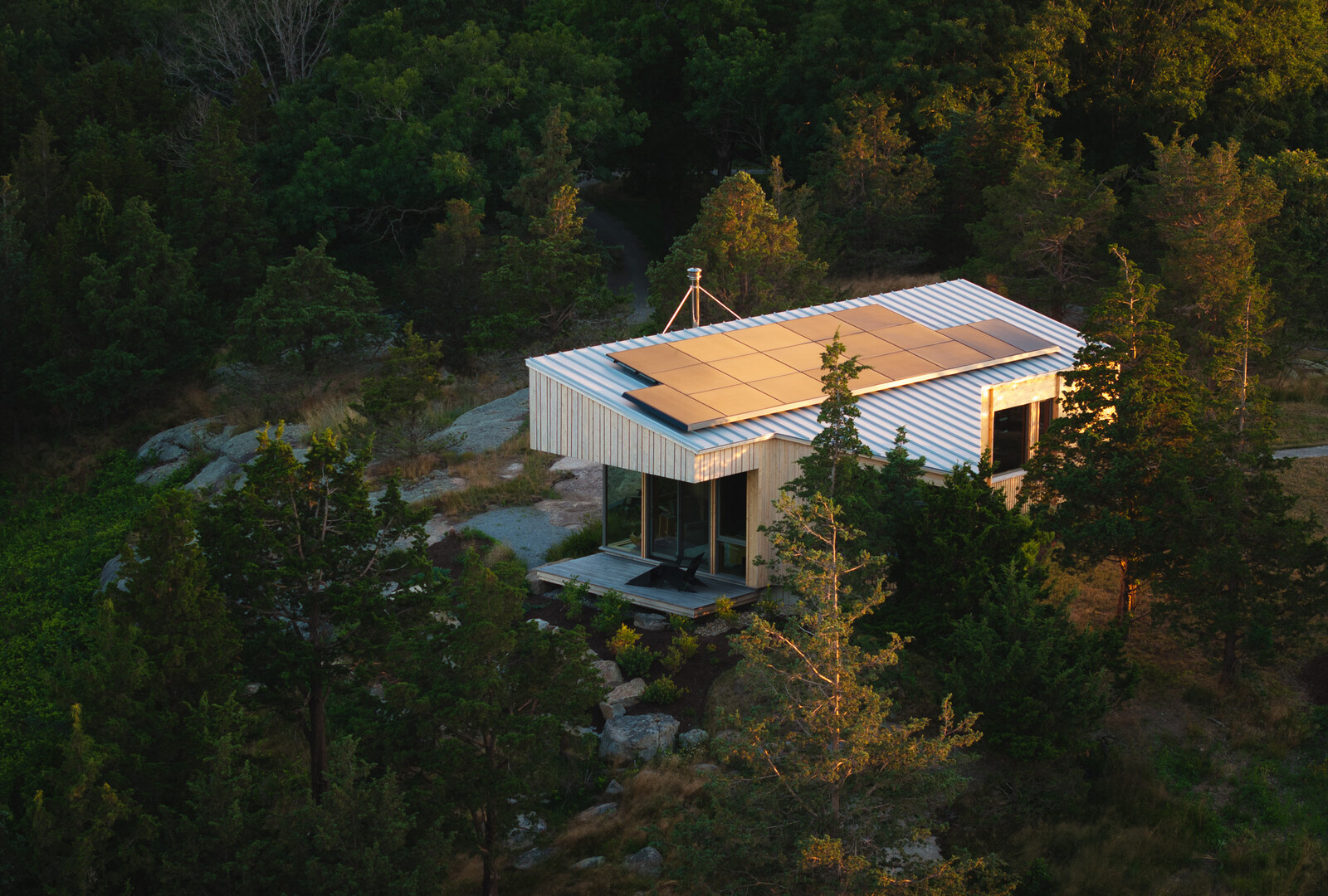

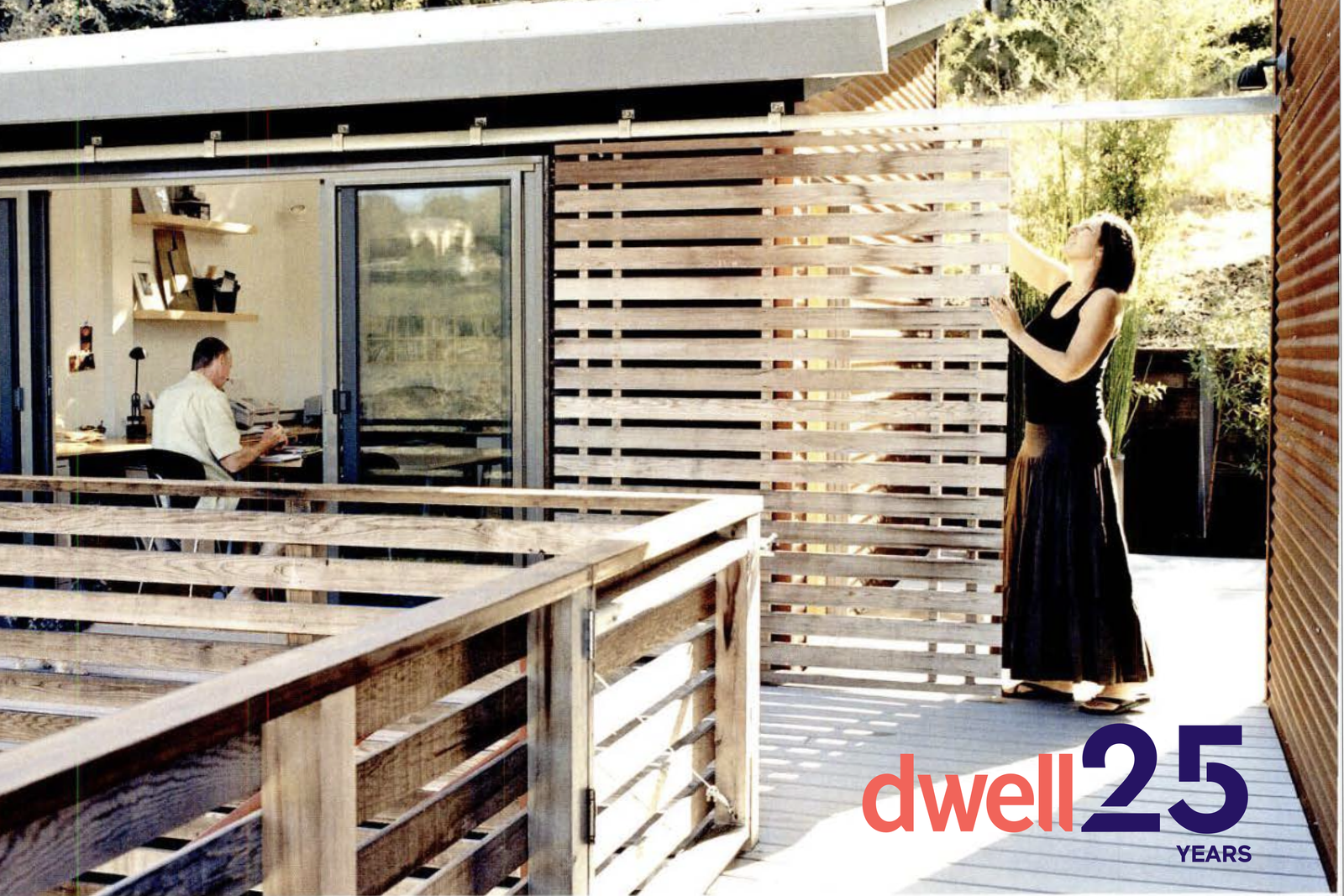
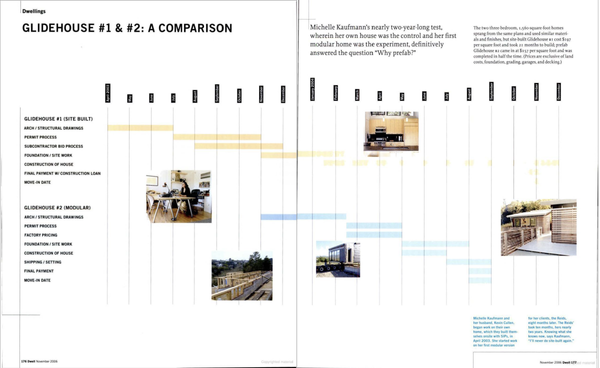
In Northern California, Michelle Kaufmann pit the construction of her site-built home against a client’s modular structure to find which could be move-in ready the quickest.
As a part of our 25th-anniversary celebration, we’re republishing formative magazine stories from before our website launched. This story previously appeared in Dwell’s November 2006 issue.
In the much-maligned, often-overhyped, and frequently misunderstood world of prefabricated construction, one of the most common questions asked is “Why prefab?” And there is perhaps no better answer to that question than architect Michelle Kaufmann’s first two Glidehouses—one prefab, one not.
The process of building the two homes simultaneously gave Kaufmann the perfect laboratory in which to hone her skills and perfect her process. “I’m done with site-built,” she says. “Going through this convinced me of the benefits of modular.”
Photos courtesy Nick Gunderson/The Oregonian (Duotone Images)
Like many first-time home buyers, Kaufmann and her husband, Kevin Cullen, were frustrated by what the market had to offer. In the astronomically priced San Francisco Bay Area, where a modest single-family home for $750,000 is considered a “deal,” there were precious few houses in their price range—and those that were were not at all the sort of places they saw themselves living in. After months of Sundays spent trudging through open houses, Kaufmann, who’d recently left Frank Gehry’s architectural office, and Cullen, a builder and woodworker, changed their strategy. In the spring of 2003, they found land in Novato, California (25 miles north of San Francisco), on which to build their own home. “We were excited,” says Kaufmann, “and luckily naive, not knowing what was ahead. Had we actually known, I think we would have been very afraid.”
Things began to move as rapidly as their search for land. A design had to be submitted within the 45-day escrow period. Cullen, who would act as general contractor, was pushing for as sustainable a house as possible.
“My 83-year-old Uncle Joe instilled a great respect for the outdoors in me and was the first person I ever heard talk about sustainable building,” explains Cullen. “So I’d been hearing about things like passive solar, photovoltaics, water catchment and renewable resources for years.”
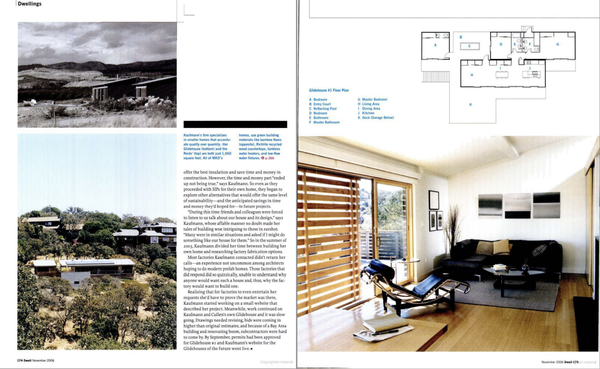
“Sustainability is the driving force of what we do,” says Kaufmann of her firm, Michelle Kaufmann Designs (MKD). Accordingly, Kaufmann and Cullen opted for structural insulated panels (SIPs), believing they would offer the best insulation and save time and money in construction. However, the time and money part “ended up not being true,” says Kaufmann. So even as they proceeded with SIPs for their own home, they began to explore other alternatives that would offer the same level of sustainability—and the anticipated savings in time and money they’d hoped for—in future projects.
“During this time friends and colleagues were forced to listen to us talk about our house and its design,” says Kaufmann, whose affable manner no doubt made her tales of building woe intriguing to those in earshot. “Many were in similar situations and asked if I might do something like our house for them.” So in the summer of 2003, Kaufmann divided her time between building her own home and researching factory fabrication options.
Most factories Kaufmann contacted didn’t return her calls—an experience not uncommon among architects hoping to do modern prefab homes. Those factories that did respond did so quizzically, unable to understand why anyone would want such a house and, thus, why the factory would want to build one.
See the full story on Dwell.com: From the Archive: An Architect’s High Stakes Prefab Competition
Related stories: